Order now from Amazon
How to Be
Wrong Less Often
The Art of Finding Gaps in Your Thinking
Millennia of human civilization. Thirteen mental models. One question: How can you be wrong less often?
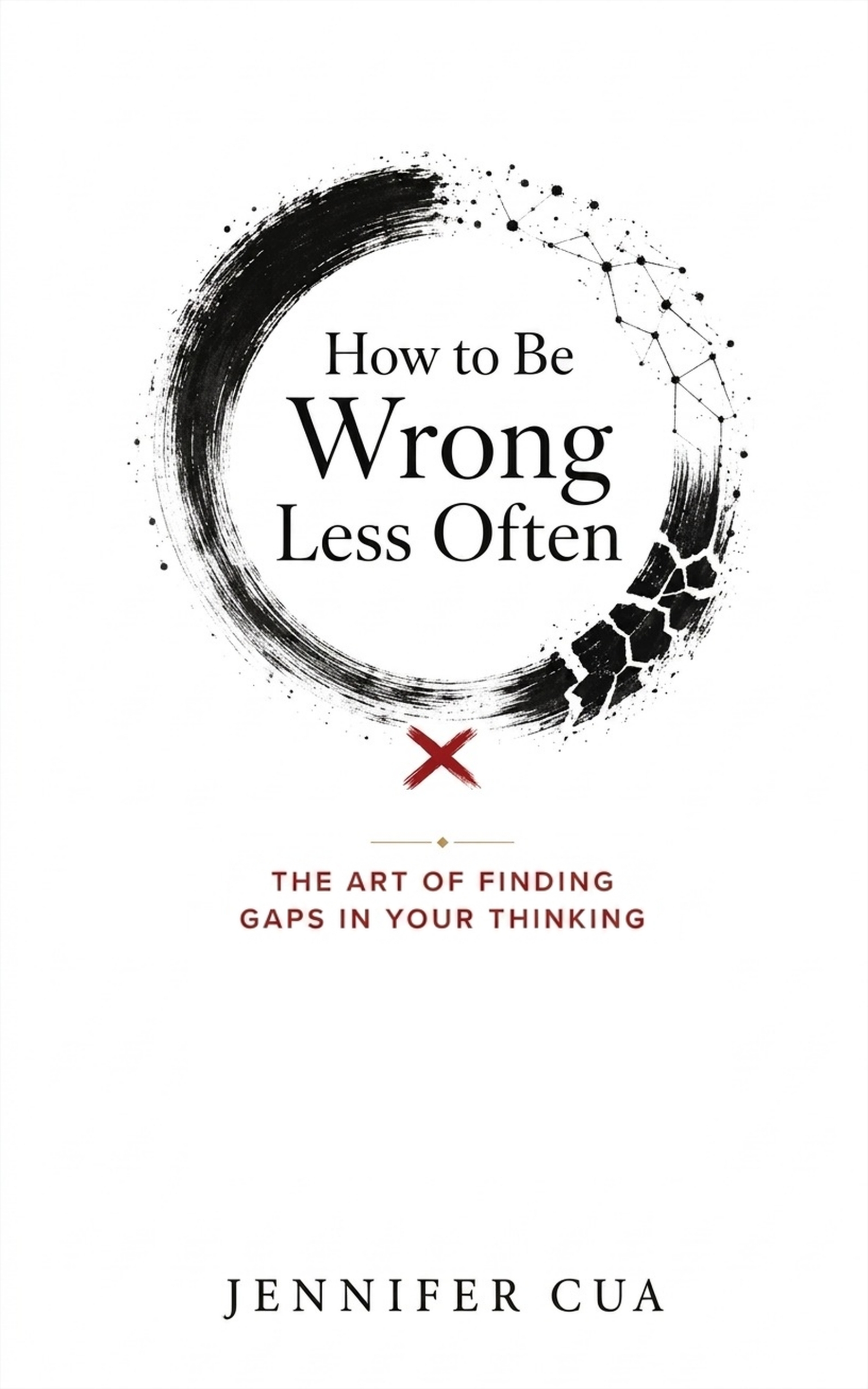
The Art of Finding Gaps in Your Thinking
Millennia of human civilization. Thirteen mental models. One question: How can you be wrong less often?
Millennia of human civilization. Thirteen mental models.
About the Book
You’re living through the most information-rich moment in human history. At the same time, you’re being lied to more skillfully than any generation before you. None of that is going to change. What can change is how well you think.
• Know when to question what you take for granted.
• Look beyond the first consequence.
• Recognize when your mind gets in the way.
Thirteen mental models that are universally valuable. Time and again, these models have emerged globally—from ancient Greece and the Baltic states to Kenya, China, India, and beyond. Whenever humanity has tried to think clearly in turbulent times, it has rediscovered the same foundational principles. Drawing on stories from history and modern life, this book turns abstract ideas into concrete questions you can use to sharpen your daily thinking. Each chapter concludes with a practical exercise to try immediately, whether you are weighing a career choice, working through a problem, or deciding what to believe.
You do not need to know everything. Begin by asking better questions.
Think for yourself. Then help someone else do the same.
Inside the Book
Model 1
First Principles
Separate what is known to be true from what has been inherited as true. Build only from the first.
Model 2
The Map Is Not the Territory
Every representation of reality is a simplification. The question is whether your map is good enough for the decisions at hand.
Model 3
Circle of Competence
A circle of competence is defined by tested experience — not confidence. The boundary matters more than the size.
Model 4
Problem Inversion
Before asking how to succeed, ask what guarantees failure. The backward question reveals what the forward question misses.
Model 5
Second-Order Thinking
After every decision, ask: and then what? The first-order effect is rarely the only one that matters.
Model 6
The Devil's Advocate
The most reliable way to improve any decision is to build the strongest possible case against it before you finalize it.
Model 7
Confirmation Bias
We form beliefs, then see a version of reality filtered through them. The filter operates automatically and feels like normal careful thinking.
Model 8
Incentive-Caused Bias
Incentives shape beliefs before they shape actions — below the level of conscious awareness. Trace the structure before you trust the conclusion.
Model 9
Availability Bias
The most memorable event is almost never the most representative one. Vivid is not the same as frequent.
Model 10
Compounding
Consistent effort, given enough time, produces outcomes that defy intuition. The most powerful force in any system is also the hardest to feel working.
Model 11
Feedback Loops
Before changing a persistent outcome, find which loop is producing it. Pushing harder on an output without understanding its loop rarely works.
Model 12
The Dichotomy of Control
The only variable in any situation that is reliably yours is your response. Not the outcome. Not the circumstances. Your response.
Model 13
The Examined Life
Every mental model in this book is available to anyone. What determines whether it produces better thinking or elaborate rationalization is honesty.